
Love, Attachment, and Healing in Modern Relationships
We have never had more ways to connect. We meet through apps, talk across continents on video, and carry endless advice about love and attachment in our pockets. And yet many people still feel unseen, misunderstood, or quietly alone in their closest relationships.
Modern relationships ask for more than they used to. Beyond commitment and shared plans, people now hope to feel emotionally safe, understood, and free to be themselves. The questions have shifted. Less often “Will this last?” and more often, “Do I feel safe here? Can we recover after a fight? Do we actually understand each other?”
As a psychotherapist, I think of a relationship as a living emotional system. It is not just two people who sometimes disagree. It is the place where each person’s history, hopes, and old wounds meet. When trouble shows up on the surface — as conflict, distance, jealousy, or silence — there is usually a quieter story underneath. Most often it is a longing to feel chosen, valued, and securely connected.
Why Love Feels Harder Now
Technology has widened how we meet and stay in touch, but it has added new pressures too. Apps offer more options and can also make us feel replaceable. Social media keeps us connected and feeds comparison and insecurity. A steady stream of texting can build closeness or quietly manufacture anxiety about who replied, and how fast.
Layer on demanding jobs, financial strain, cultural transitions, blended families, and old trauma, and the real challenge often isn’t love itself. It’s the emotional skill it takes to sustain love in a fast, noisy world. A couple can care deeply and still struggle to talk. A person can want closeness and fear it at the same time. These contradictions usually aren’t signs of failure. They are signs that something tender is being touched.
What’s Really Underneath the Argument
Most conflicts look practical on the surface — money, chores, sex, time, in-laws, phones. Those things matter, but they often carry a deeper message. A fight about texting can really be about feeling unimportant. A standoff about housework can be about feeling unsupported. A recurring clash about family can be about loyalty and belonging.
In therapy, the aim isn’t to decide who is right. As long as a couple stays at the surface, the same argument tends to repeat. The more useful question is gentler: what happens between the two of you when you both end up hurt and disconnected?
From Blame to Pattern
One of the most freeing shifts a couple can make is to stop blaming each other and start noticing the cycle they fall into together. Often one partner reaches for connection through criticism or pressing questions, driven underneath by a fear of not mattering. The other pulls back, goes quiet, or gets defensive, driven underneath by a fear of failing and never getting it right.
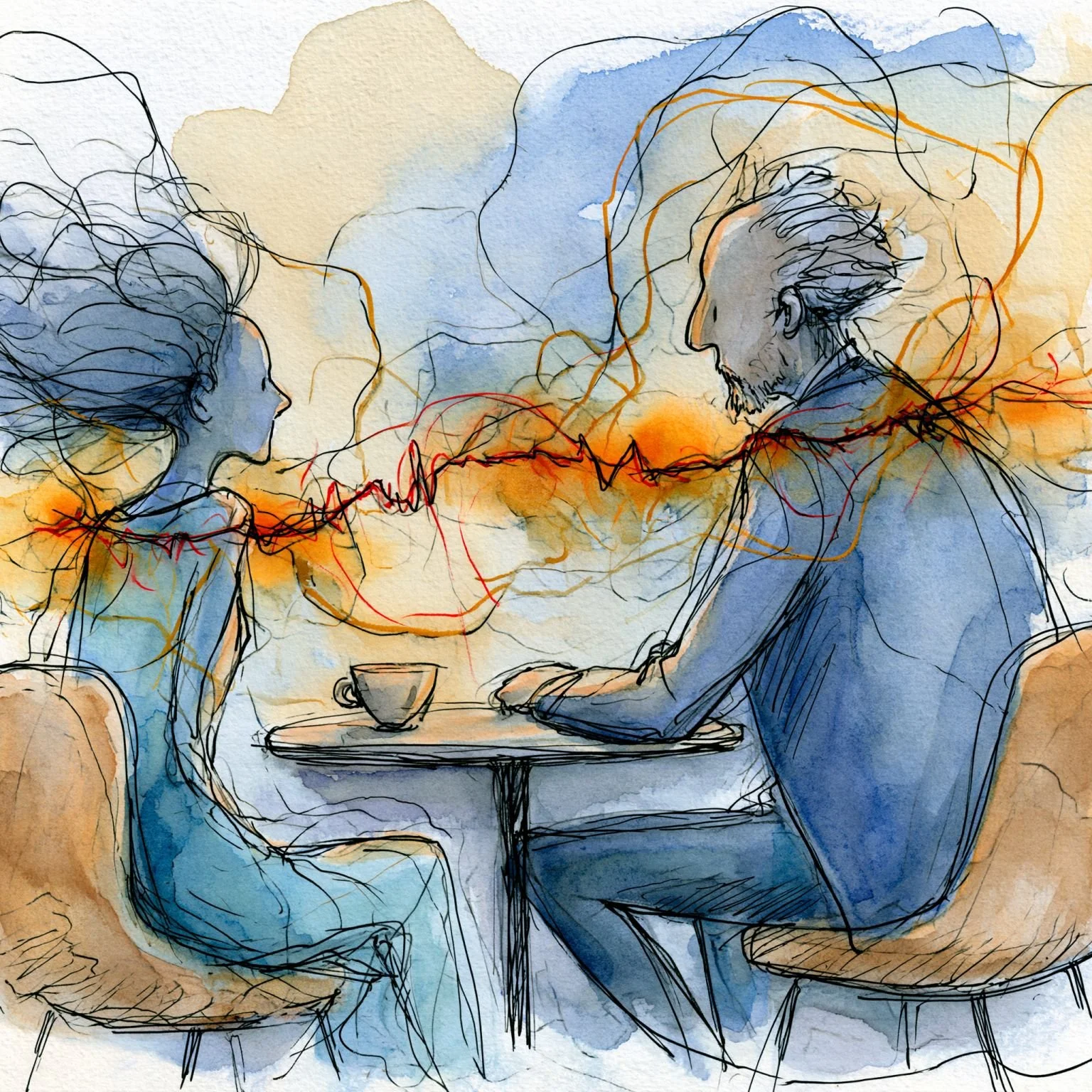
The more one pursues, the more the other retreats — and around it goes. Both end up lonely, and the relationship starts to feel unsafe, not because love has gone, but because the pattern has taken over. The relief comes when partners stop seeing each other as the problem and start seeing the cycle as the problem. The question becomes: how do we get pulled into this, and how do we find our way back?
Emotionally Focused Therapy: Tending the Bond
Emotionally Focused Couple Therapy (EFCT) is one of the most respected approaches to couple distress. It rests on a simple idea from attachment science: we are wired for connection, and most couple pain flares up when that bond feels threatened.
Beneath anger or withdrawal are quieter questions — Do I matter to you? Will you be there? Am I too much, or not enough? EFCT helps couples spot their cycle, reach the softer feelings hiding under the reactive ones, and build new moments of responsiveness. Communication usually improves, but the deeper goal is emotional safety.
In practice it can sound like a small but powerful change. Instead of “You never care about me,” a partner learns to say, “When you go quiet, I feel alone and scared I don’t matter to you.” Instead of “You’re always attacking me,” the other can say, “When I hear your frustration, I feel like I’m failing you, so I shut down.” Those honest disclosures are what let a couple move from attack-and-retreat back toward each other.
The Parts We Bring With Us
Internal Family Systems (IFS) offers another helpful lens. It recognizes that none of us is just one thing inside. We carry different parts — an anxious part that fears rejection, a protective part that gets angry, a people-pleasing part that smooths things over, a guarded part that won’t trust easily. These parts aren’t flaws. They usually formed to protect us from pain.
Someone may grow controlling because a part of them dreads abandonment. Someone may go distant because a part of them learned long ago that closeness leads to hurt. IFS invites curiosity instead of judgment: rather than “Why am I like this?” the question becomes “What part of me is activated, and what is it trying to protect?” When people understand their own inner world, they’re far less likely to hand their partner the blame. “A part of me feels scared right now” lands very differently from “You’re making me feel this way.”
When the Whole Family Is Involved
Sometimes the system is bigger than the couple. Emotion-Focused Family Therapy (EFFT) helps parents, partners, and caregivers support a loved one through anxiety, depression, addiction, or other struggles. Many families love each other deeply and still don’t know how to respond to distress — so they offer advice, or fall silent, or get overwhelmed.
EFFT helps family members become more attuned and confident: to validate feelings, repair old hurts, and offer support in a way that draws a loved one closer rather than deepening shame. It’s a reminder that healing doesn’t only happen inside one person. It happens between people, too.
Communication Matters — Safety Matters More
People often arrive saying, “We just need to communicate better.” That’s usually true, but communication problems are almost always safety problems. When the nervous system feels threatened, even good skills evaporate. Healthy communication isn’t only about the right words. It’s the ability to stay present while being honest, to listen without immediately defending, and to come back and repair after things go sideways.
Emotional safety means both people can bring forward a feeling or a fear without being dismissed, mocked, or abandoned. It doesn’t make hard conversations easy. It makes them survivable — held with enough care that the relationship doesn’t buckle under the weight of conflict.
How Old Wounds Show Up
We carry our earlier relationships into our current ones, often without meaning to. Someone who knew emotional neglect may become exquisitely sensitive to distance. Someone raised on criticism may bristle at feedback. Someone who was betrayed may struggle to trust reassurance, even when it’s genuine. Trauma also lives in the body, shaping how we meet closeness, conflict, and silence — sometimes as fight or flight, sometimes as freezing, fawning, or going numb.
A trauma-informed view doesn’t excuse harmful behaviour. It simply asks a kinder, more useful question: not “What’s wrong with this person?” but “What happened to them?” That shift makes room for compassion while still working toward real accountability and change.
Boundaries and Repair
Boundaries get talked about constantly, and often misunderstood. A boundary isn’t a tool to control someone else. It’s a way of naming what feels healthy and sustainable for you. Far from creating distance, clear boundaries usually make a relationship safer, because both people know where they stand. A strong relationship leaves room for closeness and individuality at once; you don’t have to disappear to love someone well.
No relationship avoids rupture. What sets healthier ones apart isn’t the absence of conflict — it’s the willingness to repair: to acknowledge harm, take responsibility, hear its impact, and turn back toward connection. Many people resist repair because they confuse accountability with shame, so they defend or minimize instead. True repair asks for humility and a real change in behaviour. In therapy it’s often the most transformative moment of all — when vulnerability is met with care, the whole relationship starts to reorganize around safety instead of fear.
Sometimes the Work Begins With Yourself
Relationship healing doesn’t only happen in couples therapy. A great deal of it happens in individual work, where people notice the patterns that follow them — “Why do I keep choosing people who can’t show up? Why do I lose myself? Why do I shut down when someone gets close?” Understanding your attachment style, your family history, and your own protective parts tends to change your relationships from the inside out. Often the most important relationship to tend first is the one you have with yourself.
A Gentler Invitation
Love is more than chemistry or compatibility. It’s the ongoing practice of presence, repair, honesty, and curiosity. Relationships aren’t healed by winning arguments or avoiding hard truths. They’re healed by courage, compassion, and a willingness to understand what’s happening beneath the surface.
In a world that rewards speed and self-protection, therapy offers something countercultural: the chance to slow down, listen deeply, and reach for one another in new ways. Relational healing is possible. It starts the moment we get curious about our patterns, gentle with our wounds, and willing to try again.
This article is for educational purposes and isn’t a substitute for individual or couples therapy. If you’re navigating relationship distress and would like support, you’re welcome to reach out to book a confidential consultation — there’s no pressure, just a conversation about what you’re looking for.
